10 Practical Ways to Improve Employee Engagement Through Workplace Gamification
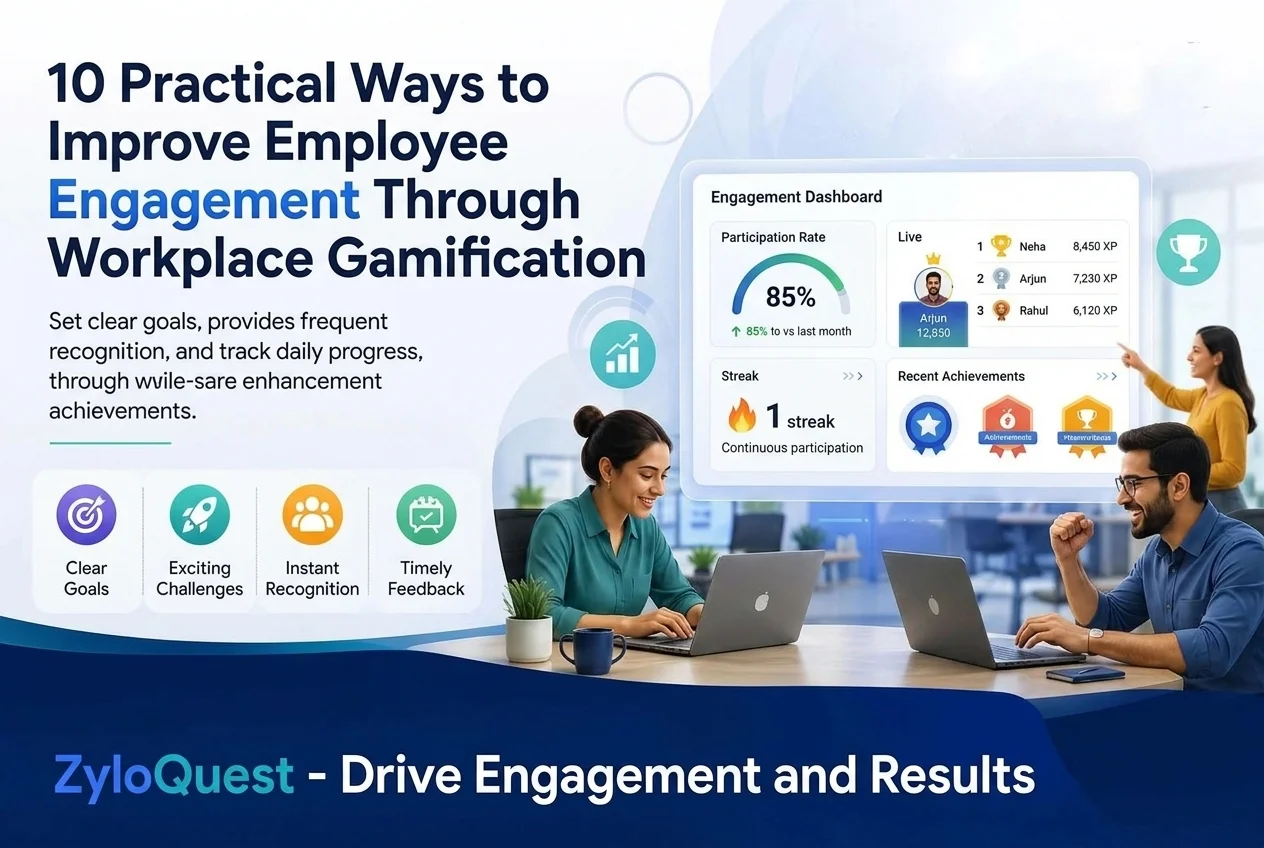
Employee engagement is hard today. Work is fast, focus is short, and posters or long emails do not help much. Workplace gamification gives people clear goals, quick feedback, and fair rewards. It turns daily tasks into simple steps, lifting motivation, productivity, and teamwork without heavy oversight. By designing workplace challenges around autonomy, competence, and recognition, ZyloQuest helps organizations turn routine tasks into engaging habits.
Employee engagement is hard today. Work is fast. Focus is short. Posters and long emails do not help much. Workplace gamification gives people clear goals, quick feedback, and fair rewards. It turns daily tasks into simple steps. This lifts motivation, productivity, and teamwork without heavy oversight.
Employee engagement is the energy and effort people choose to give at work. It is not just being happy. It is caring enough to try, and to keep trying. Gallup’s long-running meta-analyses show that highly engaged teams have 21% higher profitability and 41% lower absenteeism than low-engagement teams.
Engagement is the fuel for productivity. Output is what you make. Engagement is why you make it, and how steady you stay. People can be productive for a short time without care. But it will not last. When people feel purpose, have clear goals, and see progress each day, they focus more and quit less.
Engagement drops when work feels dull, unclear, or unseen. Repetitive tasks drain energy. Vague goals create confusion. A lack of recognition lowers drive. Delayed feedback locks people in place. Over time, people withdraw. That hurts team results and morale.
The science is clear. Self-Determination Theory (Deci and Ryan) says people need three things to stay engaged: autonomy, competence, and relatedness (source: SDT overview). Give choice, build skill, and help people feel part of a team. When those needs go unmet, effort fades. Small nudges, clear wins, and fair praise bring it back.
For a deeper view on the root causes, see why employee productivity drops and what actually fixes it.
Clarity beats noise. Use SMART goals or OKRs to define “what good looks like.” SMART means specific, measurable, achievable, relevant, and time-bound. OKRs pair a bold objective with a few key results. Both give people a simple target and a fair measure.
Keep goals short and concrete. Example: “Close five net-new deals in the mid-market segment this month,” not “Sell more.” Tie goals to the team mission. Show a sample of “done” work. Limit active goals per person to avoid overload. Review progress weekly. Adjust scope, not standards.
A challenge is a goal with clear steps, a start, and a finish. Gamification adds points, levels, and streaks so progress is visible. The BJ Fogg Behavior Model says action happens when motivation, ability, and prompts meet. Good challenges deliver all three.
Break big work into small tasks. Try a “pipeline health” challenge with daily 10-minute blocks for new outreach, follow-ups, and cleanup. Add milestone badges for each stage. Use themes people enjoy. Keep the first step very easy. Do not gamify creative outputs end-to-end. Instead, gamify the repeatable inputs that feed them.
People crave progress and praise. Teresa Amabile’s research calls this the “progress principle” (source: HBR - The Power of Small Wins). Small wins, seen and named, fuel big effort. Recognition should be fast, specific, and tied to impact. Say what happened, why it mattered, and thank the person.
Make recognition a habit. Give frequent, bite-size praise, not one big award a year. Use peer shout-outs in weekly stand-ups. Keep a visible “wins” feed. Issue value-based badges. Recognize learning too, like first-time demos, first bug fixes, and first safety suggestions. Public praise. Private coaching.
One size fits no one. Tailor challenges to the work. Sales, HR, Operations, and IT all need different cues. Personalization shows respect for context and skill. It also keeps the game fair. For example, Sales can track demos set, cycle time by stage, and pipeline hygiene; HR can track time-to-slate, candidate feedback rates, and onboarding completion; Operations can track first-pass yield, on-time orders, and safety checks; IT can track first-contact resolution, mean time to resolve, and knowledge-base usage. Set thresholds by role level so new and senior staff both have a fair shot.
People improve faster when they see feedback now, not next month. Real-time feedback closes the loop. It lets people adjust while the work is fresh. It also lowers stress. Small fixes are easier than big rework.
Keep feedback simple. Show the metric and the trend in plain words. Offer one next step. Alert on real risk, not every blip. Pair data with a short note on what to try. Avoid shaming. Focus on learning and next moves. Share “what good looks like” examples alongside charts. If you want to lift participation without nagging, study how to increase employee participation without sending more reminders.
Competition should lift effort, not create fear. Keep it fair, inclusive, and time-boxed. Leaderboards help when you design them with care. Segment by role or region so skills match. Reset rankings often, such as weekly or monthly. Spotlight “most improved” and “best assist,” not just the top rank. Let people opt in to public standings and offer private views. Use team-versus-team when tasks vary a lot. Do not rank creative work quality with a single score. Compete on inputs, cycle time, and learning goals instead.
Rewards work when they feel fair and personal. They do not need to be big. Small, frequent rewards keep habits alive. Mix intrinsic and extrinsic rewards. Offer gift cards, time off, learning credits, charity donations, or special projects. Tie rewards to clear behaviors and outcomes. Set transparent rules and budgets. Let people pick from a catalog so it fits their life. Avoid winner-take-all. Spread rewards across progress, assists, and steady habits. Pair rewards with recognition so people feel seen, not scored.
We engage more when we can see progress. Simple dashboards reduce status meetings and guesswork. Visibility builds trust and better coaching. Show percent-to-goal and recent wins. Display streaks for daily habits. Flag bottlenecks and risks. Use clean visuals and plain words. Share weekly snapshots with the team. Keep the tone about learning. If targets slip, ask, “What blocked us?” not “Who failed?” Progress walls and brief updates keep everyone aligned.
Teams win when they help each other. Gamify assists, not just solo heroics. Track and reward handoffs, reviews, and knowledge sharing. Add assist points when a teammate unblocks a task. Set shared targets, like “Team resolves 90% of tickets within SLA this sprint.” Run short retros each week and reward the best improvement suggestion adopted. Rotate challenge captains so leadership is shared. Measure cross-team flow, such as time from request to response, rework rates, and “first-time right” checks. Praise the helpers who make work smoother.
You improve what you measure. Track both inputs and outcomes. Inputs include logins, challenge starts, completions, recognition sent, and feedback read. Outcomes include sales closed, tickets resolved, defects reduced, and on-time delivery. Map the two. Look for patterns.
Set a baseline for engagement using Gallup Q12 themes or eNPS. Pick a few key metrics per team. Change one thing at a time and run 4–6 week tests. Share results with the team. Celebrate signals, not just wins. Keep what works. Drop what does not. Update rules each “season.” Do not gamify everything. Avoid direct points for complex creative outputs, deep research quality, or sensitive topics like patient care decisions or compliance judgments. Gamify the repeatable inputs around them instead.
Workplace gamification improves motivation, recognition, and follow-through. It breaks work into clear steps. It adds fast feedback. It rewards the right behaviors. This builds steady habits and a culture of progress.
It also aligns with how people learn. Small wins create momentum. Visible progress guides attention. Friendly competition raises effort when fair. Rewards reinforce what matters. Research from Gallup and Teresa Amabile (HBR) backs these simple levers: clarity, progress, and praise drive better work.
Gamify outreach, pipeline health, and win rate. Run a weekly “10-10-10” challenge: 10 new contacts, 10 follow-ups, and 10 CRM cleanups. Add stage badges for discovery, demo, and proposal quality checks. Reward partner assists and clean pipeline deletes. Use tiered leaderboards so new reps compete fairly. Track the activity mix by segment, cycle time by stage, and demo-to-close rate. Coach with call reviews and deal hygiene checks, not just counts.
Gamify hiring, onboarding, and mobility. Track time-to-slate and candidate feedback response rates. Build onboarding quests with 30-60-90 day milestones. Reward hiring managers who give on-time reviews and quality scorecards. Add badges for internal moves and cross-training. Track offer acceptance rate, new hire time-to-productivity, and candidate experience scores from short surveys. Use data to find steps that speed hires and remove those that slow them.
Gamify quality, throughput, and safety. Use daily start-up checklists and “no-defect” streaks. Run defect-burst sprints with root-cause write-ups. Set shared points for on-time orders across shifts. Reward ideas that cut waste and reduce changeover time. Track first-pass yield, takt-time variance, and near-miss reports. Share line-level dashboards at stand-up. Keep improvements small and repeatable.
Gamify ticket flow, SLAs, and knowledge sharing. Set goals for mean time to resolve and first-contact resolution. Add badges for root-cause analyses and incident drills. Run monthly game-days with team scores on recovery time. Reward knowledge-base articles that reduce repeat tickets. Track backlog health, reopen rates, and SLA risk alerts. Use trends by service and shift to staff smart and reduce “hero mode.”
Good candidates include repeatable inputs like outreach, follow-ups, checklists, and reviews; learning loops such as retros, post-mortems, and knowledge sharing; service health measures like SLA adherence, response time, and backlog hygiene; and safety and quality routines including inspections and first-pass checks.
Poor candidates include complex creative outputs such as full campaign quality; sensitive judgments like compliance approvals or clinical calls; and one-off, rare events that resist fair comparison. Use a simple rule of thumb: gamify behaviors that are clear, frequent, and measurable. Keep scoring rules simple and transparent. Review them each season.
Define success upfront and pick two or three outcome metrics per team. Instrument the journey to log starts, finishes, and assists. Compare cohorts, such as those in a challenge versus a similar group not in it. Time-box tests for 4–6 weeks with a clean start and end. Control for seasonality by avoiding peak holidays or known surges. Share the findings, including what changed, by how much, and what stays. Use data to learn, not to punish. Keep privacy in mind. Aggregate where needed. Ask the team what the data missed.
ZyloQuest is a practical platform for everyday employee engagement and workplace gamification. It turns goals into clear challenges. It adds recognition, rewards, and real-time feedback. It tracks progress so people see where they stand. It lets you tailor rules by team and role.
Key ways ZyloQuest helps include personalized challenges tied to OKRs or KPIs, real-time feedback and timely nudges, flexible employee recognition with value-based tags, meaningful rewards with a broad catalog and budgets, leaderboards and private leagues for fair play, clear goal tracking with analytics that link actions to outcomes, and custom rules, seasons, and events that keep things fresh. This is not fluff. It is a simple system that builds habits. It fits HR, Sales, Operations, and IT. It scales from pilot to full rollout and gives leaders the insight to coach and improve.
Employee engagement is the energy and effort people choose to give at work. It blends purpose, clear goals, and daily progress. Gallup links high engagement to 21% higher profitability and 41% lower absenteeism. Engaged teams also show better quality and retention across roles.
Gamification makes progress visible, feedback instant, and rewards meaningful. Challenges turn big goals into small steps. Points and badges reinforce habits. Fair leaderboards add friendly competition. This reduces friction and lifts motivation, which raises participation, quality, and on-time delivery. See Amabile’s “small wins” research.
Gamify clear, repeatable behaviors like outreach, follow-ups, checklists, and SLA adherence. Avoid gamifying complex creative outputs or sensitive judgments. Keep rules fair and transparent. Review scoring each season. Focus on inputs and learning loops; let quality and outcomes follow from better habits.